
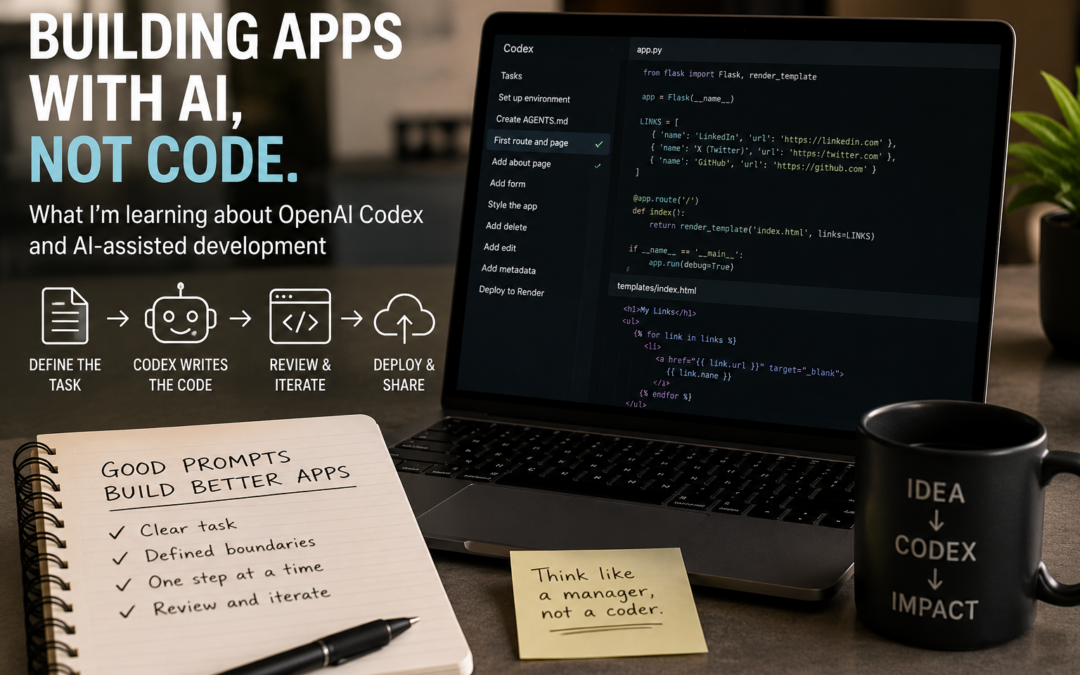
Over the past few days I’ve started exploring OpenAI Codex through LinkedIn Learning’s “OpenAI Codex 101: From Idea to Deployed App” course — and it’s already changing the way I think about software, AI, and journalism workflows.
The course centres around building a simple “link in bio” web app using AI-assisted development. According to the course materials, the project uses Python, Flask, BeautifulSoup, Requests and Gunicorn, with deployment handled through Render.
What’s interesting is that the course isn’t really teaching traditional coding in the way many people imagine.
It’s teaching how to direct an AI coding agent effectively.
The introduction frames Codex as an “AI coding agent” that can:
- write code
- run code
- help fix problems
- assist with deployment
…while the user focuses on directing tasks and reviewing outputs.
That distinction matters.
Because after working through the opening chapters, I’m increasingly convinced this is less about replacing developers and more about changing the role humans play in software creation.
The first major concept introduced was setting up a proper working environment:
- creating a GitHub repository
- connecting it to Codex
- configuring dependencies
- understanding how Codex interacts with a project structure
The workflow feels surprisingly accessible for non-developers. Instead of spending weeks learning syntax before building anything, the emphasis is on understanding systems, instructions, and task management.
The most eye-opening part so far has been learning about the AGENTS.md file.
This file acts like a standing briefing document for the AI agent:
- project overview
- technology stack
- file structure expectations
- coding conventions
- testing instructions
As a journalist, this immediately reminded me of editorial style guides and newsroom workflows.
You don’t explain legal standards or formatting rules every time a reporter files a story. You create persistent instructions so work remains consistent.
That’s effectively what this file does for AI-assisted development.
The next lesson focused on something equally important: prompt discipline.
One of the strongest ideas in the course is that vague prompts create chaotic outcomes.
Instead of asking the AI to “build an app,” the course encourages users to break work into tightly-scoped, reviewable tasks. The example exercises progressively build a simple Flask application one small feature at a time:
- a single route
- a basic page
- navigation
- forms
- styling
- editing
- deleting
- metadata handling
Each task is intentionally isolated.
That incremental approach feels extremely familiar from investigative journalism.
Large investigations are rarely solved in one leap. They’re broken into manageable stages:
- obtain records
- identify anomalies
- test assumptions
- verify evidence
- isolate timelines
- build structure gradually
The same logic appears to apply to AI-assisted coding.
And honestly, that may be the biggest lesson so far.
The skill isn’t necessarily “being the best programmer in the room.”
The skill is:
- defining scope clearly
- reducing ambiguity
- building systems incrementally
- reviewing outputs critically
- maintaining control over complexity
In other words, many of the same skills editors and investigative journalists already use daily.
Another thing the course does well is demystifying AI-generated code.
The workflow encourages constant review rather than blind trust. Codex may generate the implementation, but the user is expected to:
- inspect changes
- understand outputs
- accept or reject modifications
- iterate carefully
That “human as editor” model resonates strongly with me.
Especially in journalism, where AI outputs always require scrutiny, verification, and judgement.
I’m already starting to think beyond the demo app itself.
The underlying ideas could potentially apply to:
- council spending trackers
- FOI management systems
- OSINT monitoring tools
- automated document analysis
- planning application parsing
- meeting transcript analysis
- investigative data dashboards
The course hasn’t magically turned me into a software engineer overnight, there’s still plenty to go through 🙂